

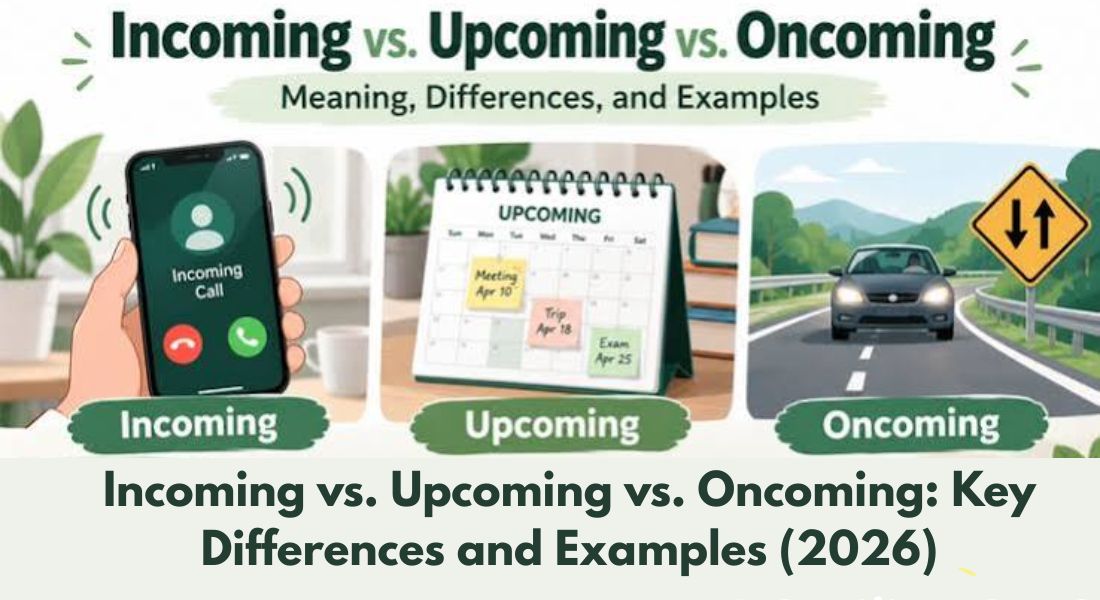
Incoming, upcoming, and oncoming can all describe something that is approaching, but they are not interchangeable. Incoming usually refers to something arriving or being received, upcoming describes something that will happen soon, and oncoming refers to something moving toward a person, place, or object.
Understanding these differences will help you choose the right word in everyday conversations, text messages, emails, and professional writing.
What Does Incoming Mean?
Incoming describes something that is arriving, being received, or moving toward a particular destination. People commonly use it for phone calls, messages, deliveries, information, and people who are arriving.
For example, an incoming call is a call you are receiving. An incoming package is one that is on its way to you.
Examples of Incoming in Sentences
- I have an incoming call from my manager.
- You have an incoming message from your friend.
- The office is preparing for incoming employees.
- We received an incoming shipment this morning.
- The team is reviewing incoming customer requests.
When Should You Use Incoming?
Use incoming when something is arriving, being received, or coming toward a destination.
Common expressions include:
- Incoming call
- Incoming message
- Incoming email
- Incoming shipment
- Incoming students
- Incoming information
Easy tip: Incoming is often associated with receiving something.
What Does Upcoming Mean?
Upcoming refers to an event, activity, date, or situation that will happen soon. Unlike incoming, it usually focuses on time rather than physical movement or receiving something.
People often use this word when discussing meetings, holidays, exams, deadlines, celebrations, and future plans.
For example, an upcoming meeting is a meeting scheduled for the near future. It does not mean the meeting is physically moving toward you.
Examples of Upcoming in Sentences
- I am preparing for an upcoming exam.
- Our upcoming meeting is scheduled for Monday.
- She is excited about her upcoming birthday.
- The company announced an upcoming product launch.
- We need to finish this task before the upcoming deadline.
When Should You Use Upcoming?
Choose upcoming when you are talking about something planned or expected to happen in the near future.
Common expressions include:
- Upcoming event
- Upcoming meeting
- Upcoming exam
- Upcoming holiday
- Upcoming deadline
- Upcoming release
Easy tip: Upcoming is about something that will happen soon.
What Does Oncoming Mean?
Oncoming describes someone or something moving toward you or toward a particular point. It often appears in discussions about traffic, vehicles, waves, storms, and other forms of movement.
For example, an oncoming car is a car moving toward you. The word emphasizes the direction of movement rather than simply the fact that something will arrive.
Examples of Oncoming in Sentences
- The driver slowed down to avoid an oncoming car.
- She waited for the oncoming traffic to pass.
- The boat faced the oncoming waves.
- We could see an oncoming train in the distance.
- The cyclist moved aside to avoid an oncoming vehicle.
When Should You Use Oncoming?
Use oncoming when something is moving toward a person, vehicle, place, or object.
Common expressions include:
- Oncoming traffic
- Oncoming vehicle
- Oncoming car
- Oncoming train
- Oncoming waves
- Oncoming storm
Easy tip: Oncoming usually emphasizes movement in your direction.
Incoming vs. Upcoming vs. Oncoming: Key Differences
The main difference is what each word emphasizes. Incoming focuses on arrival or receipt, upcoming focuses on future timing, and oncoming focuses on movement toward something.
| Word | Main meaning | Common use | Example |
| Incoming | Arriving or being received | Calls, messages, deliveries | I have an incoming call. |
| Upcoming | Happening soon | Events, meetings, deadlines | The upcoming event starts tomorrow. |
| Oncoming | Moving toward something | Traffic, vehicles, waves | An oncoming car approached us. |
Meaning Differences Table
| Situation | Best word | Example |
| A phone call you are receiving | Incoming | I answered the incoming call. |
| An event scheduled for next week | Upcoming | Our upcoming event is next week. |
| A vehicle moving toward you | Oncoming | The oncoming truck slowed down. |
| A package being delivered to you | Incoming | The incoming package arrived today. |
| An exam that will happen soon | Upcoming | My upcoming exam is on Friday. |
| Traffic approaching your vehicle | Oncoming | Watch out for oncoming traffic. |
Best Word Choice by Scenario
Choosing the right word becomes easier when you consider whether you mean arrival, time, or movement.
- Use incoming for something being received or arriving, such as a message, call, or shipment.
- Use upcoming for something planned or expected to happen soon, such as a meeting, holiday, or exam.
- Use oncoming for something physically moving toward you, such as a car, train, or wave.
Some situations allow more than one word, but the meaning can change slightly. For instance, an incoming storm emphasizes a storm that is approaching or arriving, while an oncoming storm emphasizes its movement toward a place.
Incoming vs. Upcoming: What Is the Difference?
Incoming and upcoming can seem similar because both may refer to something that has not fully arrived. However, they focus on different ideas.
Incoming is commonly used for something arriving or being received. Upcoming refers to an event or situation expected to happen soon.
Compare these examples:
- Incoming email: An email that is arriving or being received.
- Upcoming meeting: A meeting that will take place soon.
- Incoming shipment: Goods that are on their way to a destination.
- Upcoming holiday: A holiday that will occur in the near future.
You would normally say, “I have an incoming call,” rather than “I have an upcoming call” when your phone is ringing. However, “upcoming call” can refer to a call scheduled for a future time.
Incoming vs. Oncoming: What Is the Difference?
Incoming and oncoming both describe something approaching, but their usual contexts differ.
Incoming often describes something arriving at a destination or being received. Oncoming specifically emphasizes movement toward a person, place, or object.
For example:
- Incoming message: A message being received.
- Oncoming vehicle: A vehicle moving toward you.
- Incoming shipment: A delivery on its way to its destination.
- Oncoming traffic: Vehicles approaching from the opposite direction.
The two words may overlap when discussing weather. An incoming storm is a storm approaching or arriving, while an oncoming storm highlights its movement toward a location.
Upcoming vs. Oncoming: What Is the Difference?
Upcoming and oncoming are different because one usually relates to time while the other relates to direction.
Upcoming describes something that will happen soon. Oncoming describes something moving toward a particular point.
Here are a few examples:
- Upcoming wedding: A wedding that will happen soon.
- Oncoming car: A car moving toward you.
- Upcoming deadline: A deadline that is approaching in time.
- Oncoming waves: Waves moving toward a person, boat, or shoreline.
You can say, “My upcoming interview is tomorrow,” because the interview is a future event. You would say, “The oncoming car forced us to stop,” because the car was moving toward you.
Common Mistakes When Using Incoming, Upcoming, and Oncoming
These words are easy to confuse, especially when describing something that is approaching. The following mistakes show how to use each term correctly.
Using Upcoming for a Received Message
Incorrect: “I have an upcoming message from my friend.”
Correct: “I have an incoming message from my friend.”
An incoming message is being received. An upcoming message would suggest a message expected to arrive in the future, but it is not the usual expression for a message notification.
Using Incoming for a Future Event
Incorrect: “We are excited about our incoming birthday party.”
Better: “We are excited about our upcoming birthday party.”
The party is a future event, so upcoming is the natural choice. Incoming would sound unusual in this context.
Using Upcoming for Approaching Traffic
Incorrect: “Be careful of the upcoming car.”
Correct: “Be careful of the oncoming car.”
An oncoming car is moving toward you. The word upcoming does not normally describe a vehicle approaching on the road.
Using Oncoming for a Scheduled Meeting
Incorrect: “I need to prepare for my oncoming meeting.”
Correct: “I need to prepare for my upcoming meeting.”
A meeting is a future event rather than a physical object moving toward you. Therefore, upcoming is the better choice.
Easy Ways to Remember the Difference
A simple memory trick can help you choose the right word without overthinking the sentence.
- Incoming = arriving: Think of an incoming call, email, or package.
- Upcoming = happening soon: Think of an upcoming exam, meeting, or holiday.
- Oncoming = moving toward you: Think of an oncoming car, train, or wave.
Before choosing a word, ask yourself what you want to describe. If something is being received, use incoming. If an event will happen soon, use upcoming. If something is moving toward a point, use oncoming.
Conclusion
Incoming, upcoming, and oncoming have related meanings, but each word serves a different purpose. Incoming usually describes something arriving or being received, such as a call or package. Upcoming refers to something that will happen soon, including meetings, exams, and special events. Oncoming describes something moving toward a person or place, such as a car or wave.
When choosing between these words, focus on whether you mean arrival, future timing, or direction of movement. This simple distinction will help you use all three words correctly in everyday conversations and writing.
Frequently Asked Questions
Is incoming the same as upcoming?
No. Incoming usually describes something arriving or being received, while upcoming refers to an event or situation that will happen soon.
Is oncoming the same as incoming?
Not exactly. Incoming often refers to arrivals or received items, whereas oncoming emphasizes movement toward a person, place, or object.
Can I use upcoming for a meeting?
Yes. Upcoming is the natural choice for a meeting scheduled in the near future, such as an upcoming team meeting or client appointment.
Is it correct to say incoming traffic?
Yes, but the context matters. Incoming traffic can describe traffic arriving at a location, while oncoming traffic usually means vehicles approaching from the opposite direction.
Which word should I use for a future event?
Use upcoming for a future event, such as an upcoming wedding, exam, meeting, or holiday. It is the most natural choice when discussing something planned for soon.
