

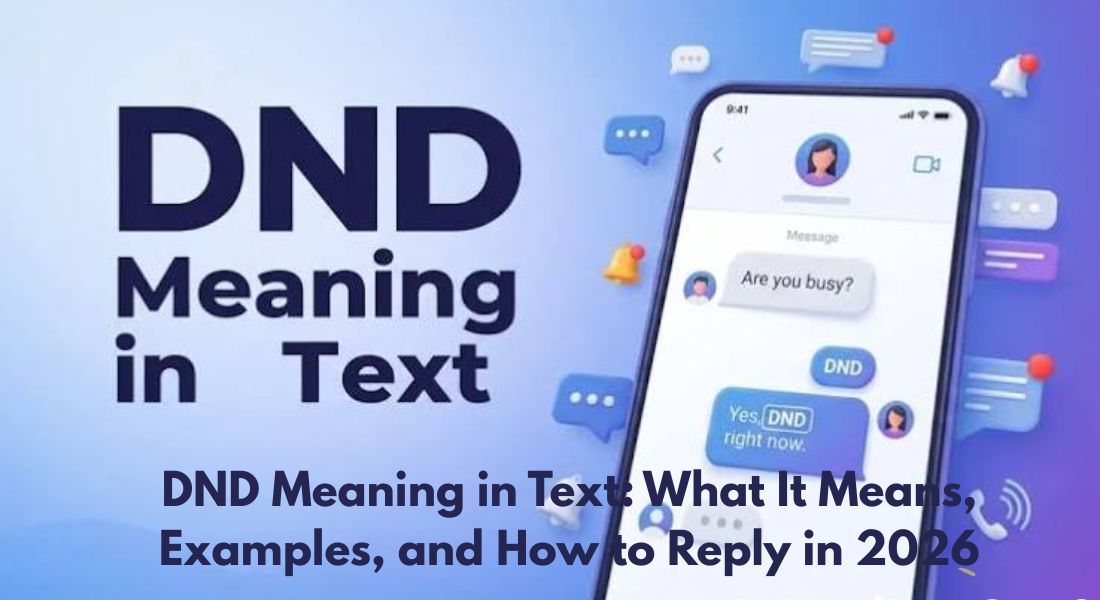
Have you received a message containing “DND” and wondered what it means? In texting, DND usually stands for “Do Not Disturb.” People use it when they need quiet time, want to focus on a task, or prefer not to receive interruptions.
You may see DND in text messages, phone settings, social media profiles, workplace chats, and gaming communities. Although its main meaning stays the same, its use depends on the situation.
For example, a friend might use DND to explain why they are not replying, while a phone user may activate the setting to silence notifications. This guide covers the DND meaning in text, common examples, social media uses, and appropriate ways to respond.
DND Meaning in Text
DND means “Do Not Disturb.” In a text conversation, it usually indicates that someone wants fewer interruptions or will be unavailable for a while.
Here are a few examples:
- “Going on DND for an hour.”
- “I’m on DND. Talk later.”
- “DND until I finish studying.”
- “Please respect my DND time tonight.”
These messages communicate a need for uninterrupted time. The person might be working, studying, sleeping, or taking a break from their phone.
However, DND does not automatically mean someone is ignoring you. They may simply want to finish a task before returning to the conversation.
What Does DND Stand For?
DND stands for Do Not Disturb. It is a short way to express a need for privacy, concentration, or quiet time.
The phrase appears in everyday conversations and digital settings. For instance, someone can activate a phone’s DND feature or tell a friend they are going DND for the evening.
What Is the Simple Meaning of DND?
In simple English, DND means “Please don’t interrupt me right now.”
The person may respond later when they have more time. Therefore, it is usually best to respect their request instead of assuming they are upset.
Where Does DND Come From?
The phrase “Do Not Disturb” existed long before smartphones became popular. Hotels commonly used signs with these words to ask visitors and staff not to enter a guest’s room unnecessarily.
Later, smartphones introduced Do Not Disturb settings that allowed users to silence or filter notifications without turning off their devices. Eventually, DND became a familiar abbreviation in everyday digital communication.
How DND Is Used in Modern Texting
DND can refer to a phone setting, a personal boundary, or a busy status. The surrounding conversation usually helps you understand the intended meaning.
For example, “My phone is on DND” generally refers to notification settings. In contrast, “I’m going DND for the rest of the night” may mean the person wants a break from conversations.
People commonly use DND to:
- Focus on schoolwork or professional tasks.
- Sleep without unnecessary notifications.
- Take a break from social media.
- Spend time with friends or family.
- Avoid interruptions during important activities.
DND as a Phone Setting
People activate Do Not Disturb to manage calls, alerts, and notifications. Depending on the device, they may allow selected contacts, alarms, or apps to reach them.
For example, someone might say, “I turned on DND because I have an exam tomorrow.”
In this case, the person is describing a phone setting. Notifications may still arrive, depending on the device and its configuration.
DND as a Personal Boundary
DND can also express a need for personal space. Someone who feels tired or overwhelmed might use it to explain why they want time alone.
For instance, a person could text, “I need some quiet time, so I’m going DND for a bit.”
Rather than assuming they are angry, respect their request and allow them to reconnect when they feel ready.
DND as a Busy Status
Workplace communication tools and gaming platforms may offer a DND status. Users select it to show that they prefer not to receive unnecessary notifications.
A coworker might write, “DND until 2 PM. Please email anything urgent.”
Similarly, a gamer may activate DND before starting a competitive match. In both situations, the status communicates limited availability.
DND Meaning on Social Media
On social media, DND can indicate that someone wants a break from messages or notifications. People may include it in captions, stories, profile descriptions, or direct messages.
However, it is often an informal expression rather than a special feature of the platform.
DND on Instagram
Someone might post “DND mode” in an Instagram story to show that they are taking time away from conversations.
Instagram also offers notification-management options, including Quiet Mode where available. These features help users limit interruptions, although they are different from simply writing DND in a message.
For example, someone might post, “DND tonight. Catch up with everyone tomorrow.”
DND on WhatsApp
On WhatsApp, people may write DND in a message or status to explain that they are busy or temporarily unavailable.
For example, a user might say, “I’m on DND while working. I’ll reply later.”
However, DND is not a standard WhatsApp status that automatically blocks incoming messages. Its meaning depends on how the person uses the abbreviation.
DND on Snapchat and TikTok
Snapchat and TikTok users may use DND in captions, comments, or messages when they want privacy or a break from online conversations.
For instance, someone could write, “DND for the rest of the evening. I’ll message you tomorrow.”
In these situations, the abbreviation usually communicates limited availability. Nevertheless, the exact meaning depends on the surrounding conversation.
DND Meaning in Professional Communication
At work, DND usually indicates that someone needs uninterrupted time for a meeting, deadline, or important task.
Employees may use a DND status while preparing reports, reviewing documents, or attending online meetings. As a result, colleagues can understand why an immediate response may not be possible.
Common workplace examples include:
- “DND until 2 PM. Please email urgent updates.”
- “I’m setting my status to DND while preparing the report.”
- “Please respect my DND status during the presentation.”
- “DND for the next hour while I finish this project.”
Using DND can improve concentration and make availability clearer. However, employees should arrange another contact method when urgent requests require immediate attention.
When Should You Use DND at Work?
Consider using DND when you need to concentrate, attend a meeting, or complete a task without repeated alerts.
For example, activating the setting during a writing session may help you focus instead of checking every notification.
If your role involves emergencies, let the appropriate people know how to contact you. You can also tell your team when you expect to become available again.
DND in Gaming Communities
Gamers use DND to reduce interruptions during matches, missions, raids, and live streams. Since many games require concentration, frequent notifications can become distracting.
For example, a player might say, “DND for the next hour. We’re playing ranked matches.”
Discord also offers a Do Not Disturb status. Depending on the platform’s behavior and settings, this status indicates that the user wants fewer notification interruptions.
Importantly, DND does not necessarily mean the player is offline. They may still be online and playing with friends.
DND vs. AFK in Gaming
DND means “Do Not Disturb,” while AFK stands for “Away From Keyboard.”
A player using DND may remain active but prefer not to receive interruptions. By contrast, someone who is AFK is temporarily away from their device or controls.
For example, “DND during the tournament” means the player wants to avoid interruptions. Meanwhile, “AFK for five minutes” indicates a temporary absence.
DND Meanings Across Different Platforms
Although DND usually stands for Do Not Disturb, its exact behavior depends on the platform or device.
| Platform | Meaning or Use | Important Detail |
| iPhone | Do Not Disturb Focus | Manages interruptions according to Focus settings. |
| Android | Do Not Disturb | Controls calls and notifications according to preferences. |
| Informal message or status | Often communicates that someone is busy. | |
| Informal status or notification break | Quiet Mode is a separate feature. | |
| Snapchat | Informal message or caption | May signal privacy or a break from chatting. |
| Discord | Do Not Disturb status | Indicates that the user wants fewer notification interruptions. |
Remember that DND generally manages notifications rather than preventing messages from being delivered. The exact behavior depends on the app, device, and selected settings.
Other Places Where DND Appears
DND is not limited to texting and social media. The full phrase, “Do Not Disturb,” also appears in everyday environments where people need privacy or uninterrupted time.
Hotels
Hotels commonly display Do Not Disturb signs on guest room doors. These signs ask staff and visitors to avoid unnecessary interruptions, subject to hotel policies and safety requirements.
Healthcare Facilities
Hospitals may use signs or instructions to protect patient rest and privacy. However, DND is not a universal medical abbreviation with one meaning in every healthcare setting.
Aviation, Military, and Corporate Settings
Aviation and military environments use specialized abbreviations that may differ from everyday texting language. Therefore, you should not automatically assume DND means Do Not Disturb in these settings.
Meanwhile, offices, recording studios, and filming locations may display Do Not Disturb signs during important tasks or meetings. Digital workplace tools can also help employees communicate when they need uninterrupted time.
Common Misunderstandings About DND
People sometimes misunderstand DND because they assume it always has the same meaning or effect.
Myth: DND Means Someone Is Ignoring You
Reality: The person may be busy, resting, studying, or concentrating. A delayed response alone does not prove that they are ignoring you.
Instead, consider the surrounding conversation before drawing conclusions.
Myth: DND Stops Messages From Being Delivered
Reality: DND usually silences or filters notifications rather than blocking message delivery. However, the exact behavior depends on the device and app.
Myth: DND Is the Same as Airplane Mode
Reality: These features serve different purposes. DND manages interruptions, while Airplane Mode disables cellular connections and may disable other wireless connections.
Many devices allow users to turn Wi-Fi or Bluetooth back on manually while Airplane Mode remains active.
Myth: DND Has the Same Meaning Everywhere
Reality: Do Not Disturb is the usual meaning in texting and phone settings, but specialized environments may use different definitions. Context is important when interpreting unfamiliar abbreviations.
Similar Terms and Alternatives to DND
Several texting abbreviations and phone features are related to DND. However, each one communicates something slightly different.
| Term | Full Form or Meaning | How It Differs |
| AFK | Away From Keyboard | Indicates that someone is away from their device. |
| BRB | Be Right Back | Suggests a short absence. |
| GTG | Got to Go | Means someone needs to leave. |
| Busy | Occupied | Indicates that someone has something to do. |
| Offline | Not connected or available online | Describes online availability or connection status. |
| Silent Mode | Phone sound setting | Usually silences sounds according to device settings. |
| Mute Chat | Silence notifications from a conversation | Usually applies to a particular chat. |
| DND | Do Not Disturb | Communicates a need for fewer interruptions. |
These terms may appear in similar conversations, but they are not interchangeable in every situation. For instance, BRB usually suggests that someone will return shortly, while DND does not promise a specific return time.
How to Respond When Someone Texts You “DND”
The best response is usually short, polite, and respectful. If someone says they are on DND, acknowledge the message and give them time to respond.
Simple and Respectful Replies
You can use these responses in everyday conversations:
- “Got it. Talk later!”
- “No problem!”
- “Sure, message me when you’re free.”
- “Okay, take your time.”
- “All good. Catch you later.”
These replies show that you understand the person’s request without putting pressure on them.
Professional Replies
In workplace conversations, keep your response polite and clear.
For example:
- “Understood. I’ll follow up later.”
- “Thanks for letting me know.”
- “I’ll email the details so you can review them when available.”
- “No problem. I’ll wait until you’re free.”
Such responses acknowledge the person’s availability while keeping the conversation professional.
Replies for Friends or Partners
When someone close to you needs space, a warm response can help them feel understood.
Consider these options:
- “No worries. Get some rest!”
- “Take your time. I’ll be here.”
- “Enjoy your break!”
- “That’s okay. We can talk tomorrow.”
- “Hope you enjoy some downtime.”
However, avoid assuming that every DND message signals a relationship problem. Sometimes, people simply need time to themselves.
What If the Message Is Urgent?
If something genuinely requires attention, explain the reason clearly without repeatedly messaging the person.
For instance, you could say, “I understand you’re busy. This is time-sensitive, so please contact me when you can.”
If there is an immediate emergency, use an appropriate emergency contact method instead of relying on a text notification.
Chat-Style Examples of DND
These conversations show how people may use DND in different situations.
Example 1: Between Friends
Friend: “Going DND for a while. Need to study.”
You: “Sure! Good luck with your exam.”
This reply acknowledges the request and avoids unnecessary interruptions.
Example 2: At Work
Coworker: “DND until the meeting ends.”
You: “Understood. I’ll send the update by email.”
The response keeps the conversation professional while allowing the coworker to focus.
Example 3: In a Relationship
Partner: “I’m feeling overwhelmed. Going DND tonight.”
You: “I understand. Take the time you need.”
Here, the response respects the partner’s request for personal space.
Example 4: In Gaming
Player: “DND during the ranked match.”
Friend: “Got it. I’ll message you afterward.”
The exchange makes it clear that the player wants to concentrate on the game.
Example 5: Before Bed
Friend: “Phone on DND. I’m going to bed.”
You: “Sleep well! Talk tomorrow.”
In this case, the sender wants to rest without unnecessary notifications.
DND vs. Airplane Mode, Silent Mode, and Blocking
Although these features can reduce interruptions, they serve different purposes.
DND vs. Airplane Mode: DND silences or filters notifications according to your settings. Airplane Mode disables cellular connections and may disable other wireless connections. You can often enable Wi-Fi or Bluetooth manually.
DND vs. Silent Mode: Silent Mode generally turns off ringtone and notification sounds. DND can provide more control over which calls, alerts, or notifications interrupt you.
DND vs. Blocking: Blocking usually restricts a particular person’s ability to contact you through a specific service. DND normally manages interruptions without blocking that person.
DND vs. Muted Chats: Muting a chat usually silences notifications from one conversation. DND may affect notifications across your device or several apps.
Therefore, DND is generally useful when you want to remain connected while reducing interruptions.
Why DND Matters in Today’s Digital World
Messages, calls, emails, and app alerts can interrupt work, rest, and personal time. DND provides a convenient way to manage these interruptions.
Digital Boundaries Are Normal
People do not have to answer every message immediately. Taking breaks from notifications can help them focus on important tasks and spend time away from their screens.
At the same time, respecting other people’s boundaries is important. A late reply does not automatically mean someone is upset, uninterested, or deliberately avoiding you.
DND in Dating and Relationships
In dating conversations, someone may use DND to explain that they need time away from their phone or a break from chatting.
However, the abbreviation alone cannot tell you how someone feels about a relationship. It is better to respect their request and discuss any concerns calmly when both people are available.
When DND Might Not Be Enough
DND can reduce interruptions, but it cannot resolve every communication problem. If misunderstandings continue, a direct conversation may help clarify expectations and availability.
Conclusion
DND means “Do Not Disturb” in most text messages and everyday digital communication. People use it to manage notifications, focus on work, rest, or take a break from online conversations. However, it does not automatically mean someone is ignoring you, and it usually does not stop messages from being delivered.
The exact behavior depends on the device, app, and settings. When someone tells you they are on DND, respect their time and avoid unnecessary follow-ups. A simple “No problem, talk later” is often enough to keep communication clear and respectful.
FAQs About DND Meaning in Text
What Does DND Mean in Texting?
DND stands for “Do Not Disturb.” It usually means someone wants quiet, needs to focus, or is temporarily unavailable for messages.
Does DND Block Messages?
No, DND usually silences or filters notifications rather than blocking messages. The exact behavior depends on your device, app, and settings.
Is DND the Same as Airplane Mode?
No. DND manages interruptions, while Airplane Mode disables cellular connections and may disable other wireless connections.
How Do I Know What Someone Means by DND?
Look at the surrounding conversation. They may be referring to their phone settings, work schedule, gaming status, or need for personal space.
Can DND Mean Something Else?
Yes. Abbreviations can have different meanings in specialized contexts. In ordinary texting and phone settings, however, DND most commonly means “Do Not Disturb.”
